Sustainability
Upcoming Assent Webinar: Stay Ahead of Global Regulatory Changes: Your Q4 2026 Compliance Roadmap
Date: September 29, 2026
Time: 10 AM ET / 7 AM PT / 4 PM CET
Register Here: https://www.assent.com/resources/webinar/quarterly-regulatory-review/
The session will cover:
- The latest on PFAS, including evolving U.S. state-level rules and labeling requirements
- How the Packaging and Packaging Waste Regulation (PPWR) and expanding EPR frameworks are reshaping packaging compliance
- Rising supply chain traceability expectations under the EU Deforestation Regulation (EUDR)
- Increased demand for defensible forced labor due diligence
- The Ecodesign for Sustainable Products Regulation (ESPR) delegated act on iron and steel
- Revised European Sustainability Reporting Standards (ESRS) under the Corporate Sustainability Reporting Directive (CSRD)

Sustainability Regulations
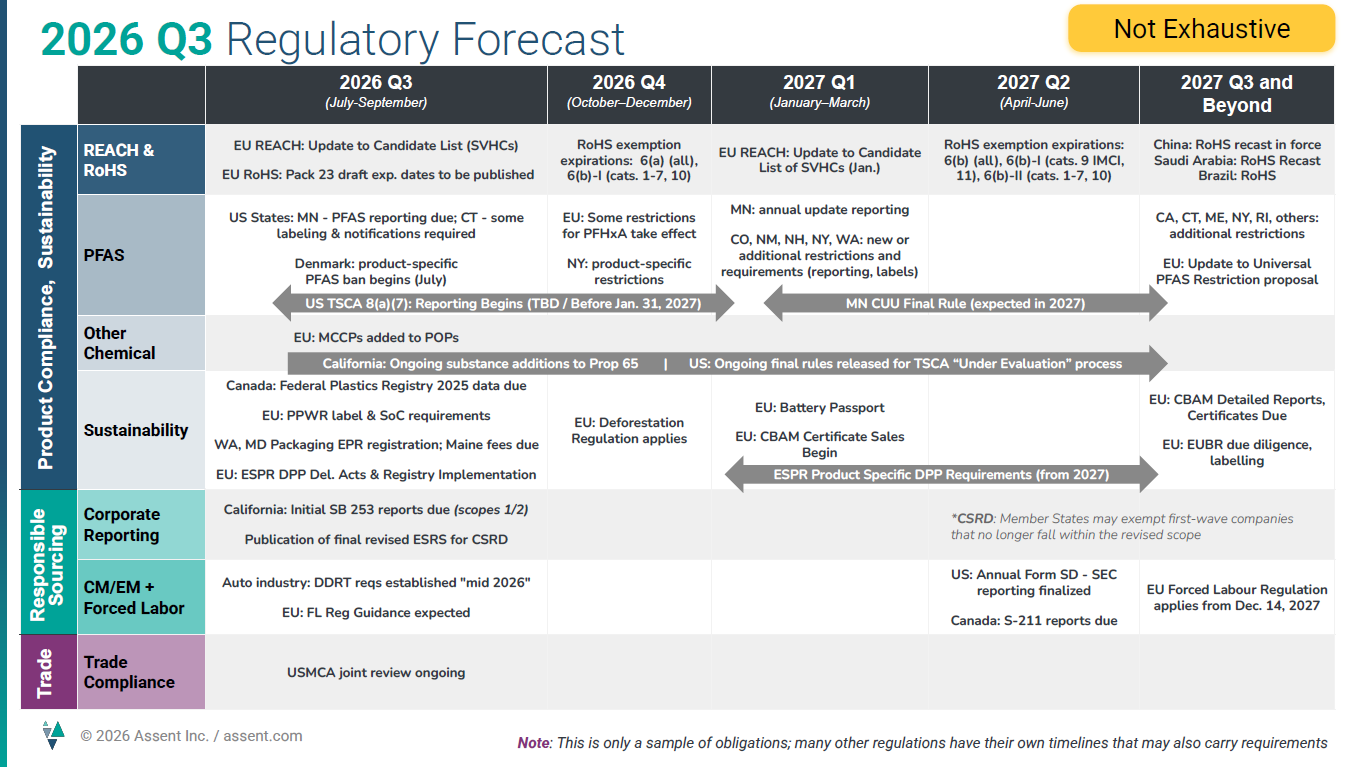
| Category | Regulation | Jurisdiction | What It Covers (Plain Language) | Effective Date / Key Deadlines | Current Status |
| Chemical & Product Compliance | California Proposition 65 (Prop 65) | California, USA | Requires warnings on products that expose consumers to chemicals known to cause cancer, birth defects, or reproductive harm. | In effect since 1986; updates to chemical list at least annually | Active and enforced. Chemical list continues to expand; enforcement actions ongoing. |
| Chemical & Product Compliance |
Toxic Substances Control Act (TSCA) | United States | Regulates commercial and industrial chemicals manufactured, processed, distributed, imported, or exported in the U.S. Certain chemical imports require certification that they comply with TSCA, and specific chemicals may be subject to additional restrictions. | In effect since 1976; compliance is ongoing. Requirements and chemical-specific restrictions are updated over time. | Active and enforced. Particularly relevant to manufacturers and importers handling regulated chemicals, lubricants, coatings, or other chemical substances. |
| Chemical & Product Compliance | TSCA Chemical Data Reporting (CDR) | United States | Requires certain manufacturers, including importers, to report information to EPA about the manufacture/import, processing, and use of chemicals when applicable reporting thresholds are met. | Reporting generally occurs every four years. Next submission period: June 1–September 30, 2028, covering production volumes from 2024–2027. | Active. Companies that manufacture or import applicable chemicals should determine whether reporting thresholds and exemptions apply. |
| Chemical & Product Compliance | REACH (Registration, Evaluation, Authorisation and Restriction of Chemicals) | European Union | Regulates the use of chemicals in products sold in the EU, requiring registration and disclosure of substances of very high concern (SVHCs). | In effect since 2007; SVHC list updated twice per year | Active and evolving. Ongoing additions to SVHC list may impact product compliance. |
| Chemical & Product Compliance | SCIP Database / EU Waste Framework Directive | European Union | Requires suppliers of articles containing certain Substances of Very High Concern (SVHCs) above 0.1% weight by weight to provide information to ECHA's SCIP database. Helps make information about substances of concern available throughout a product's lifecycle. | SCIP notification requirements have applied since January 5, 2021 for applicable articles placed on the EU market. | Active and enforced. Particularly relevant to manufacturers, importers and suppliers of articles and complex products containing REACH Candidate List substances. |
| Chemical & Product Compliance | RoHS (Restriction of Hazardous Substances) | European Union (and similar rules globally) | Restricts the use of certain hazardous substances (e.g., lead, mercury) in electrical and electronic equipment. | In effect since 2006; amendments added over time | Active and enforced. Applies to covered electronic and electrical products placed on the EU market. |
| Chemical & Product Compliance | PFAS Regulations | USA (state-level) & EU | Addresses “forever chemicals” used in products such as coatings, textiles, and packaging due to health and environmental concerns. | Varies by jurisdiction; major EU restriction proposal expected mid-to-late 2020s | Rapidly evolving. Multiple U.S. states enacting bans; EU moving toward broad restrictions. |
| Chemical & Product Compliance | Ecodesign for Sustainable Products Regulation (ESPR) / Digital Product Passport (DPP) | European Union | Establishes a framework for sustainability requirements covering products placed on the EU market, including durability, repairability, recyclability, recycled content and product information. It also establishes the EU's Digital Product Passport framework. | ESPR entered into force July 18, 2024. Product-specific requirements are being phased in through delegated acts. DPP requirements will apply progressively by product group, generally with transition periods after applicable rules are adopted. | Active and evolving. The EU's Digital Product Passport Registry went live in July 2026, but DPP obligations are being introduced progressively by product group. Companies should monitor whether their products become covered. |
| Chemical & Product Compliance | EU Waste Framework Directive / Circular Economy Requirements | European Union | Establishes the EU framework for waste prevention and management, including waste hierarchy, recycling, reuse and requirements concerning substances of concern in products. The SCIP requirements are connected to this framework. | Waste Framework Directive has been in force for many years and has been amended over time; specific requirements vary by waste stream and product type. | Active and evolving. EU circular-economy policy is increasingly influencing product design, materials, repairability, reuse and recycling requirements. |
| Climate, Carbon & Emissions | Carbon Border Adjustment Mechanism (CBAM) | European Union | Applies a carbon cost to certain imported goods based on embedded emissions, similar to EU carbon pricing. | Transitional reporting: 2023–2025 Full compliance begins: January 1, 2026 |
Active. Financial obligations begin in 2026 with certificate requirements and annual reporting. |
| Climate, Carbon & Emissions | SEC Climate Disclosure Rules | United States (SEC) | Would require public companies to disclose climate-related risks and emissions information in filings. | Originally targeted for 2026 reporting | Currently stayed. Enforcement paused pending resolution of federal litigation; future timing uncertain. |
| Climate, Carbon & Emissions | GHG Protocol – Scope 1, Scope 2 & Scope 3 Emissions | Global | Provides widely used standards for measuring corporate greenhouse gas emissions. Scope 1 covers direct emissions; Scope 2 covers emissions associated with purchased energy; Scope 3 covers other indirect value-chain emissions. | No single regulatory effective date. Used by companies and incorporated or referenced in numerous sustainability reporting programs and disclosure requirements. | Reporting framework — not itself a government regulation. Increasingly important because customers and regulatory programs may require companies to provide emissions information using these concepts. |
| Climate, Carbon & Emissions | California Climate Disclosure Rules (SB 253 & SB 261) | California, USA | Requires large companies doing business in CA to disclose greenhouse gas emissions (SB 253) and climate-related financial risks (SB 261). | SB 253: Scope 1 & 2 emissions in 2026; Scope 3 in 2027 SB 261: Originally January 1, 2026 |
SB 253 moving forward; SB 261 enforcement currently delayed due to litigation and court injunction. |
| Corporate Sustainability Reporting & Due Diligence | Corporate Sustainability Reporting Directive (CSRD) | European Union | Requires large companies to report standardized sustainability, environmental, and social data. | First reports begin 2025–2029, depending on company size and location (many delayed by two years under EU “stop-the-clock”) | Effective and in force. Phased implementation with extended timelines for many companies. |
| Corporate Sustainability Reporting & Due Diligence | Corporate Sustainability Due Diligence Directive (CSDDD) |
European Union | Requires very large companies operating in the EU to identify and address adverse human rights and environmental impacts in their own operations, subsidiaries, and global value chains. |
Entered into force July 25, 2024. EU Member States must transpose the amended Directive into national law by July 26, 2028. | Active and evolving. The Directive is in force but was amended through the EU's Omnibus I simplification initiative in 2025–2026, including changes to its scope and implementation timeline. Member States must implement the amended requirements through national law. |
| Corporate Sustainability Reporting & Due Diligence | Conflict Minerals / SEC Rule 13p-1 | United States / Global Supply Chains | Requires certain SEC-reporting companies whose products require tin, tantalum, tungsten or gold (3TG) to investigate and disclose the origin of those minerals. Manufacturers and suppliers may receive requests for sourcing information from customers subject to the rule. | Effective November 13, 2012; applicable issuers have annual disclosure requirements. | Active. Even companies not directly subject to SEC reporting may encounter conflict-minerals questionnaires and supplier due-diligence requests from customers. |
| Trade, Sourcing & Product Origin | Export Administration Regulations (EAR) / ECCN | United States | Controls exports, reexports and transfers of certain U.S.-origin products, software and technology. An Export Control Classification Number (ECCN) identifies items on the Commerce Control List and helps determine whether an export license may be required. | Ongoing compliance requirement. Export controls and restricted destinations/entities are updated regularly. | Active and enforced. Relevant to manufacturers and distributors exporting industrial products or sharing controlled technology internationally. |
| Trade, Sourcing & Product Origin | Country of Origin / U.S. Customs Marking Requirements | United States | Requires imported products to be properly marked with their country of origin and establishes rules for determining where imported goods originate. Origin can affect marking, tariffs, trade remedies and eligibility under trade programs. | Ongoing requirement for applicable goods imported into the United States. | Active and enforced. Highly relevant to distributors, importers and manufacturers sourcing bearings and industrial components internationally. |
Recent Sustainability Regulatory Updates:
- Carbon Border Adjustment Mechanism (CBAM) (EU)
- Key Date: Definitive regime began January 1, 2026
- Next Major Deadline: September 30, 2027 — first annual CBAM declaration and surrender of certificates for 2026 imports.
- Status: Active. The 2023–2025 transitional reporting period has ended. EU importers above the applicable 50-tonne threshold for covered CBAM goods must become authorized CBAM declarants. The definitive regime requires reporting of embedded emissions and corresponding CBAM financial obligations. Certificates covering 2026 emissions become available for purchase beginning in February 2027.
- Corporate Sustainability Reporting Directive (CSRD) (EU)
- Key Date: Reporting timelines and scope have changed significantly under the EU's Omnibus I simplification package.
- Status: Active, but substantially revised. The EU's “stop-the-clock” measure postponed reporting requirements by two years for companies that had not yet begun CSRD reporting. In February 2026, the EU also approved changes narrowing CSRD's scope, generally to companies with more than 1,000 employees and more than €450 million in annual net turnover, with separate thresholds for certain non-EU companies.
- Latest Update: In July 2026, the European Commission adopted revised European Sustainability Reporting Standards (ESRS), reducing mandatory datapoints by more than 60%.
- SEC Climate Disclosure Rules
- Original Timeline: The 2024 rules contemplated phased reporting beginning with certain disclosures in 2026.
- Status: Stayed and proposed for rescission. The SEC stayed the rules in April 2024 during litigation and ended its defense of them in March 2025. In September 2025, the Eighth Circuit placed the litigation in abeyance while the SEC reconsidered the rules.
- Latest Update: On May 29, 2026, the SEC formally proposed rescinding the 2024 climate-related disclosure rules in their entirety. The comment period closed August 3, 2026. The rescission is currently a proposal, so the original rules remain stayed rather than operative.
- California Climate Disclosure Rules (SB 253 & SB 261)
- SB 253 — Climate Corporate Data Accountability Act: Scope 1 and Scope 2 greenhouse-gas reporting begins in 2026. CARB established August 10, 2026 as the first-year reporting deadline and has indicated it will exercise enforcement discretion during initial implementation. Scope 3 reporting is scheduled to follow in 2027.
- SB 261 — Climate-Related Financial Risk Act: Enforcement is currently enjoined. The Ninth Circuit issued an injunction in November 2025 preventing enforcement while the appeal is pending, and CARB has stated that it will not enforce SB 261 at this time.
- Status: SB 253 is active and moving forward; SB 261 is currently subject to a court injunction.
Important Sustainability Items and Documents are Linked Below:
- Environmental Acronyms, Abbreviations and Glossary of Terms
- BSA's Introduction to ISO 14001
- BSA's Sustainability Overview
Important Sustainability Regulations are Linked Below:
- Carbon Border Adjustment Mechanism (CBAM)
- United Nations - Department of Economic and Social Affairs Sustainable Development Implementation Progress
- Corporate Sustainability Reporting Directive (CSRD)
- German Supply Chain Due Diligence Act (GSCDDA)
- EU Corporate Sustainability Due Diligence Directive (CSDDD)
- Global Reporting Initiative (GRI)
- Sustainability Accounting Standards Board (SASB)
- SEC’s Climate Disclosure Rules
- California Climate Disclosure Rule - SB 253 — Climate Corporate Data Accountability Act
- California Climate Disclosure Rule - SB 253 — Climate Corporate Data Accountability Act
Educational Programs
Click on the links below to access full schedules of live educational programs related to Sustainability.
BSA Webinar: Begin your Journey in Sustainability Compliance
Recording from the Thursday, February 29, 2024 webinar
The tools shared during discussion throughout the webinar, are available to the right of the video (or below on mobile).
Evaluate Your Supply Chain Sustainability and Risk – Free Assessments
Discover your company's Supply Chain Sustainability Maturity and Risk levels with our quick and insightful assessments. Click below to get started on improving your performance today!
BSA Member and Participating Manufacturer ESG Reports
Click on the linked cards below to access BSA Member and Participating Manufacturer ESG Information.
BSA Members:
| A&A Resources | |
| Allied Bearing & Supply Inc. | |
| Alpine Bearing | |
| Applied Industrial Technologies | Sustainability |
| B&D Industrial | |
| Baldwin Supply Co. | |
| Baleromex, S.A. de C.V. | |
| Barmex, S.A. de C.V. | |
| BDI | |
| BDI Canada, Inc. | |
| Bearing and Drive Solutions Inc | |
| Bearing Engineering Company | |
| Bearing Headquarters Company | |
| Bearing Service, Inc. | |
| BSC Industries Inc. | |
| DXP Enterprises, Inc. | Sustainability |
| Eastern Industrial Automation | |
| Fukuda Corporation | |
| General Bearing Service, Inc. | |
| Gipson Bearing & Supply Co., Inc. | |
| IBSCO - Intercontinental Bearing Supply Company, Inc. Corp | |
| IBT Industrial Solutions | |
| Interstate BearingSystems | |
| Jamaica Bearings Company, Inc. | |
| Mechanical Drives & Belting | |
| PRS Industries | |
| Purvis Industries | |
| RIRSA | |
| Rolamentos CBF Ltda. | |
| Transmission & Fluid Equipment, Inc. | |
| W.C. Du Comb Company, Inc. | |
| Wajax Limited | |
| Weimer Bearing & Transmission Inc. |
BSA Participating Manufacturers:
| Accurate Bushing Co. Inc. | |
| AMI Bearings, Inc. |
|
| Bearings Manufacturing Co. | |
| Berliss Bearing Company | |
| Bowman Bearing Technologies | |
| Bunting Bearings LLC | |
| Carter Bearings | |
| Climax Metal Products Company | |
| Consolidated Bearings Company | |
| Dodge Industrial, Inc. | |
| Freudenberg-NOK Industrial Services Corporate | |
| GMN Bearing USA | |
| Henkel LOCTITE | |
| IKO International | Sustainability |
| Isostatic Industries, Inc. | |
| JTEKT North America | Environmental Vision |
| Lubriplate Lubricants Company | |
| Nachi America Inc. | |
| New Hampshire Ball Bearings, Inc. | |
| NSK | |
| NTN Bearing Corp. of America | Sustainability at NTN |
| Oilite Bearing Div., Beemer Precision, Inc. | |
| QA1 Precision Products, Inc. | |
| Randall Bearings, Inc. | |
| RBC Bearings | |
| Regal Rexnord | Sustainability Reports |
| RotoPrecision Inc. | |
| Schaeffler Group | Sustainability at Schaeffler |
| Scheerer Bearing Corporation | |
| SKF USA Inc. | Sustainability at SKF |
| Solve Industrial Motion Group | |
| Standard Locknut, LLC | |
| Symmco, Inc. | |
| The Timken Company | Sustainability at Timken |
| Thomson Linear LLC | Sustainability Reports |
Interested in joining a BSA Committee or Task Force?
All committees must have a majority participation of Distributors vs. Manufacturers.