January 2021
Planetary Roller Screws
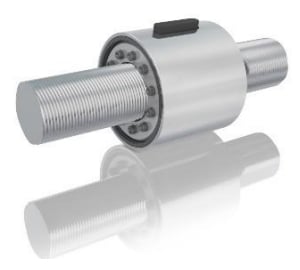 In today’s ever competitive world, more is being required by (material) handling motions. Higher precision, higher repeat accuracy and higher reliability are basic necessities in determining the success of any motion control system. Feedscrews are being asked to do more in an ever broadening array of applications. The most commonly known screws in industry today are Lead Screws and Ball Screws. These types of screw products convert rotary motion into linear motion but have their limitations. Planetary Roller Screws are also part of this broad family of devices but
having these key advantages:
- Higher static and dynamic capacities
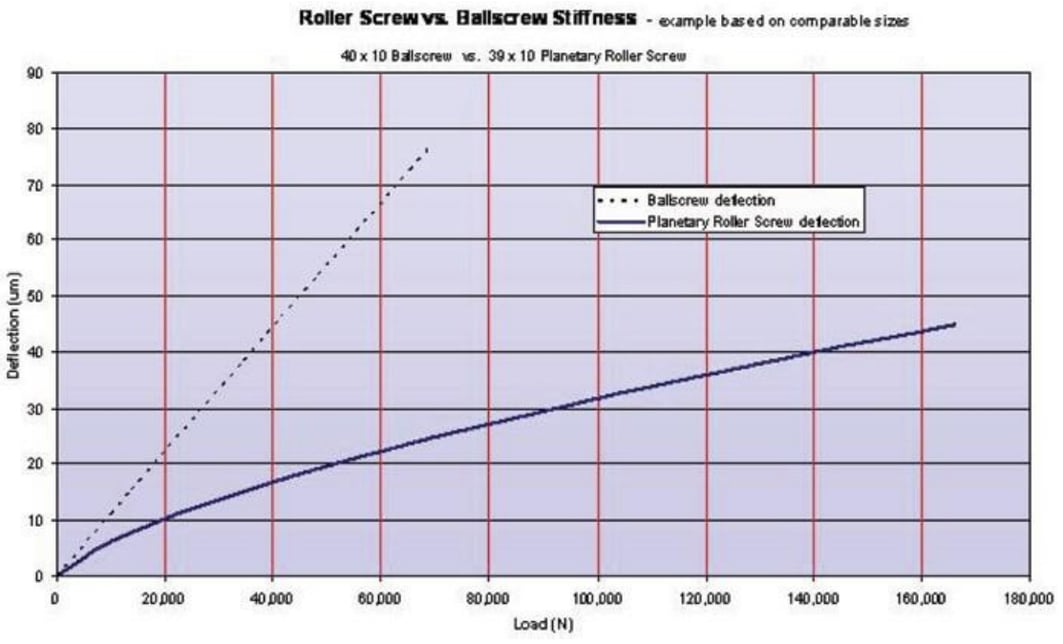
- Increased rigidity
- Lower axial clearance (backlash)
- Higher limiting speed (for the planetary type)
The internal design and configuration make these screws less sensitive to shock loads and increase their functional reliability in harsh environments while maintaining high efficiency. So often, designers who need increased rigidity add preload to the Ball Screw or Lead Screw they currently use,
shortening life and reliability. They may also compromise their rigidity when they lighten preload for higher speeds. Planetary roller screws eliminate this compromise.
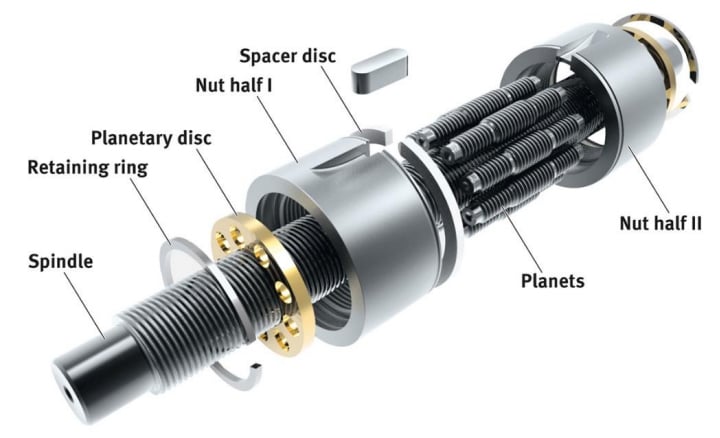
In the planetary configuration, the rollers have a timing gear at both ends. The function of the timing gear is to mesh with the ring gear fixed in the nut so the rollers are always in contact. Due to the fact that the rollers are maintained parallel to each other, as well as timed correctly with the nut, the screw operates reliably even in high acceleration applications and harsh environments. It accomplishes all this while maintaining high efficiency and rigidity.
With static and dynamic load capacities that average 2 – 3 times those of conventional ballscrews, life expectancy may increase by a factor of 20 or more. These higher capacities are increasingly important with the advent of tools capable of extreme feedrates.
The lack of recirculating elements provides for very smooth motion, which can improve surface finishes. Planetary roller screws are also available with very fine leads (down to 1mm/rev), compared to ballscrews (4 or 5 mm/revon large screws). This provides for very fine resolution, extremely important for interpolated or coordinated axis moves. Combining a finer lead with higher rpm capability offers the best of both worlds.
Planetary roller screws have a very high number of contact points as compared to ballscrews. In order to have equal load distribution within the nut, the threads of all mating components must be precisely ground. The stiffness is also considerably higher than a ballscrew and nut lengths are usually:
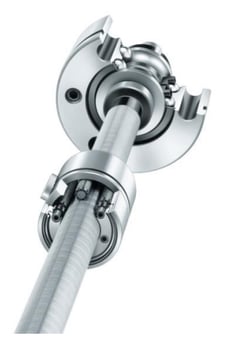 Typical Applications:
- Machine tools
- Measuring equipment
- Positioning systems
- Silicon wafer processing equipment
- Aerospace and outer space applications
- Optical equipment
- Photography equipment
- Plastic machinery
- Ordinance
- Transportation (Train tilt mechanism)
New Applications – Replacing Hydraulic Systems
Planetary roller screws are also replacing hydraulic cylinders on many large machines such as presses, broaches, extruders, and similar specialty equipment. They are very quiet, clean, and environmentally friendly by comparison. They also allow for transportability.
The Educational Services Committee acknowledges with appreciation the contribution of David Zoesch, Schaeffler Group.