March 1994, revised February 1999
Seal Selection
The first consideration in selecting a seal is to know: Is it for a new application or is it a replacement for an existing application?
Is an exact replacement seal desired or should an alternate seal be used? (There may be better choice for particular applications.)
How to select a replacement seal
Generally, seals are marked with either an OEM part number or a stock number. This number will tell you exactly which replacement seal is right for the application. If the part number is legible, refer to the seal manufacturer’s interchange for a replacement. If an identification number can’t be found, match the old seal’s size with a manufacturer’s size and type guide.
Seal Size
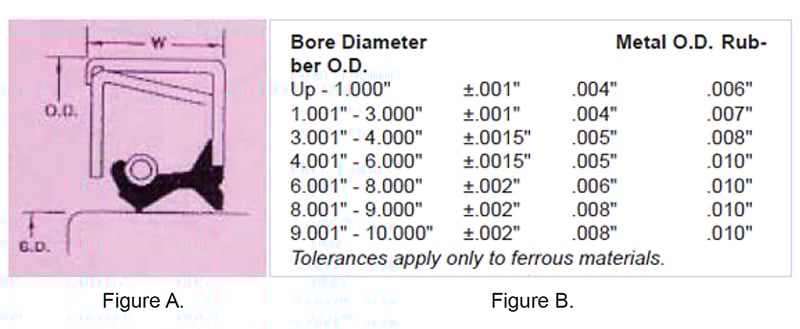
Seal size (Fig. A) is determined by:
- Seal Bore — the diameter of the hole in the housing into which the seal is fitted.
- Seal Outer Diameter (O.D.) — the press fit diameter. It is usually .004” to .008” (0.10mm to 0.20mm) larger than the bore diameter for metal seals, and .006” to .022”
(0.15mm to 55mm) for rubber case seals (Fig. B). - Seal Width (W) — the total width of the seal, including both the inner and the outer shells.
Proper Seal Measurement
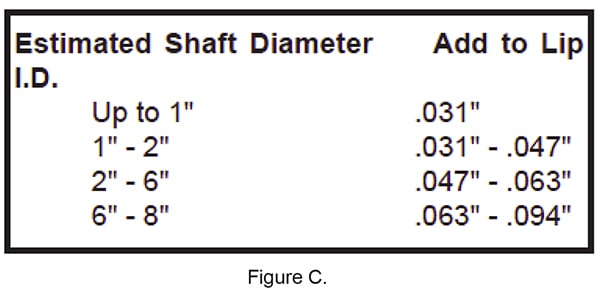
To measure the O.D. of a seal, take three measurements equally spaced around the outside of the seal. The average of the three measurements is the seal’s O.D. If the actual shaft diameter is unknown, you can estimate it by measuring the seal’s inside diameter. Average three measurements and estimate shaft size as shown in Fig. C.
Seal selection criteria
Factors to consider when selecting a seal for a particular application include:
- Basic seal function, retention and/or exclusion
- Shaft speed in fpm and shaft direction
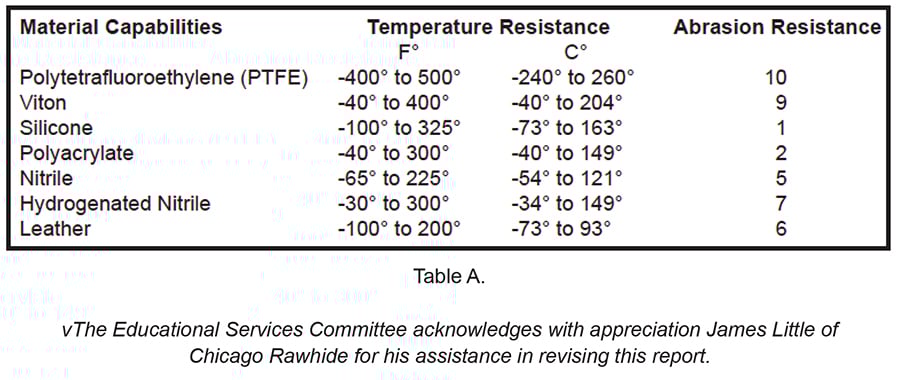
- Temperature range (Table A.)
- Operating pressure
- Fluid compatibility
- Shaft and bore conditions
In many applications, seal life can be extended simply by substituting the same size seal, but of slightly different design or with a different lip material. The seal selected must be able to meet the application’s requirements for operating temperature, pressure, and other factors listed above. Never exceed the operating temperature for the sealing material.
How to substitute a new seal for an old seal
When an exact replacement seal is not available, the best option is substitution of a similar design and material.
Common lip material substitutes include:
- Nitrile instead of felt
- Nitrile instead of leather
- Polyacrylate instead of nitrile
- Fluoroelastomer instead of polyacrylate
- Fluoroelastomer instead of silicone
Note: Substitution may reduce or extend seal life, depending on the material chosen. Consult the seal manufacturer for compatibility information.