March 2008
Smart Bearing Technology
 Proper bearing analysis is the key to keeping equipment running efficiently, reliably, consistently and cost effectively. Monitoring for and preventing costly bearing damage can enhance productivity, ensure peak performance and ultimately affect the bottom line.
Use of “smart” bearing technology is one method manufacturers can use to monitor bearing operation. Smart bearings are instrumented with sensors to provide information about their surrounding environment, including speed, direction, temperature, vibration, load, levels of debris and other factors. The integration of sensors and bearings is what gives smart bearings their name.
Once smart bearings gather the data, they feed it to a control unit that is used to monitor the particular bearing operation. For example, smart bearings used in automotive wheel applications collect speed data used to operate anti-lock brakes. Further, in industrial applications, the data collected by smart bearings is often matched with condition monitoring programs where being aware of temperature and vibration levels is essential to preventing bearing failures. Smart bearing technology is used in a variety of industries, including automotive and industrial. Specific applications include, but are not limited to: automotive wheel speed and direction feedback, machine control, robotic control, printing industries, paper converting, web processing, wood processing, chemical production, textile, agriculture machinery and food processing.
Smart Bearing Types
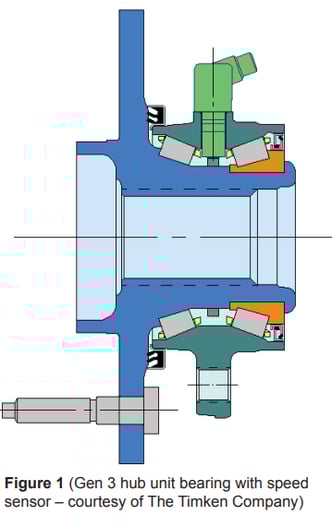
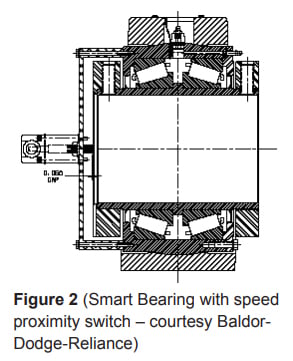 The most popular smart bearings are found in automotive wheel applications. Most automotive “hub unit” bearings commonly include speed sensors which send wheel speed data to the ABS (anti-lock brake system) and traction control units of light vehicles. Figure 1 shows one such hub unit bearing. In the industrial markets, housed bearing units can be equipped with sensors that monitor bearing speed, vibration, temperature or a combination of all three. Figure 2 shows a smart bearing that is using a speed pickup proximity switch. The speed pickup proximity switch senses the presence of two targets on a special collar or locknut inside the sensorized bearing housing. When a target comes into range the proximity switch closes, allowing the supplied voltage to pass through. The time between the two pulses per revolution may be measured to determine the shaft speed.
Available Sensors
The types of sensors that create smart bearings also range in capabilities and usage. For industrial applications, sensors are available to measure speed, direction, temperature (thermocouple) and vibration (accelerometer).
Conditions Monitoring
Manufacturers continue to further explore the benefits and uses for smart bearings in specific applications. Currently, smart bearings are evolving to have the ability to measure bearing system performance and predict the remaining useful life.
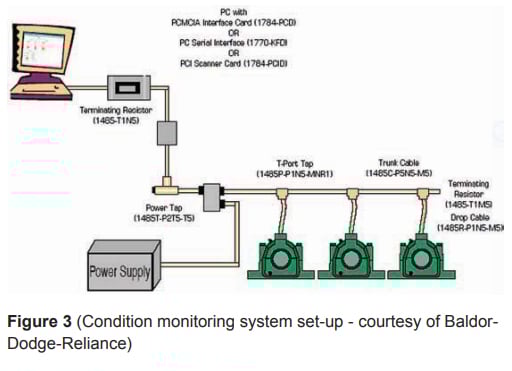 Condition monitoring units are yet another option in predictive bearing maintenance technology and can be used in conjunction with smart bearing
sensors. Just as sensors are being used to transmit data to a source, condition monitoring units are external devices that can receive data on the operating conditions of equipment to ensure peak performance. Together, these devices can communicate to an operator when critical machine
elements have become worn, contaminated, damaged, improperly lubricated or experience a rise in temperature or vibration – all leading to
potentially costly down time and repairs. Figure 3 shows an example of combining smart bearings into a system and feeding data to a PC as part of a
condition monitoring program. Smart bearings can send the performance data via wireless or wired arrangements.
As industries continue to grow and develop, additional smart bearing sensor data is needed to more closely monitor proper bearing function which is so essential to optimal operation. Advancements in bearing technology, including data sharing and maintenance tracking, will continue to be researched and developed for more applications.